

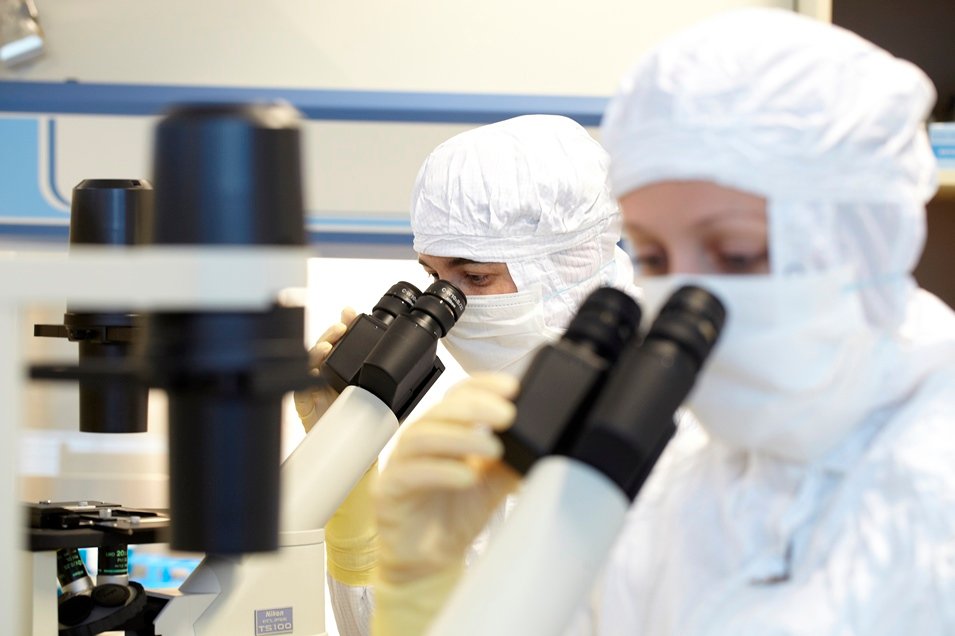
AI-driven drug discovery, state-of-the-art laboratories, novel compounds, and nanomaterials. Czech biotechnology generates nearly CZK 100 billion annually and is beginning to gain confidence.
When biotechnologist Julie Proft returned to Prague after spending several years in Canada and first stepped into Jan Konvalinka’s laboratory at the Institute of Organic Chemistry and Biochemistry of the Czech Academy of Sciences (IOCB Prague), one detail told her more about the local research environment than any stack of annual reports ever could.
“There was an ultracentrifuge on every floor. A shaker on every floor,” recalls the current Deputy Director of IOCB Tech. “In Canada, I had to hunt for that kind of equipment. It was always booked and never readily available. Here, we have it all. The entire infrastructure, plus brilliant minds and experts we can approach and talk to,” she says.
Proft now serves as Deputy Director of IOCB Tech, an organization established as the professional technology transfer office of IOCB Prague. Its mission is to identify commercially promising research projects and help bring them into the business world. The organization has played a key role in negotiating and concluding more than a dozen major licensing agreements with leading pharmaceutical companies, including Gilead Sciences, Merck, and Novo Nordisk, generating billions of Czech crowns in licensing revenues.
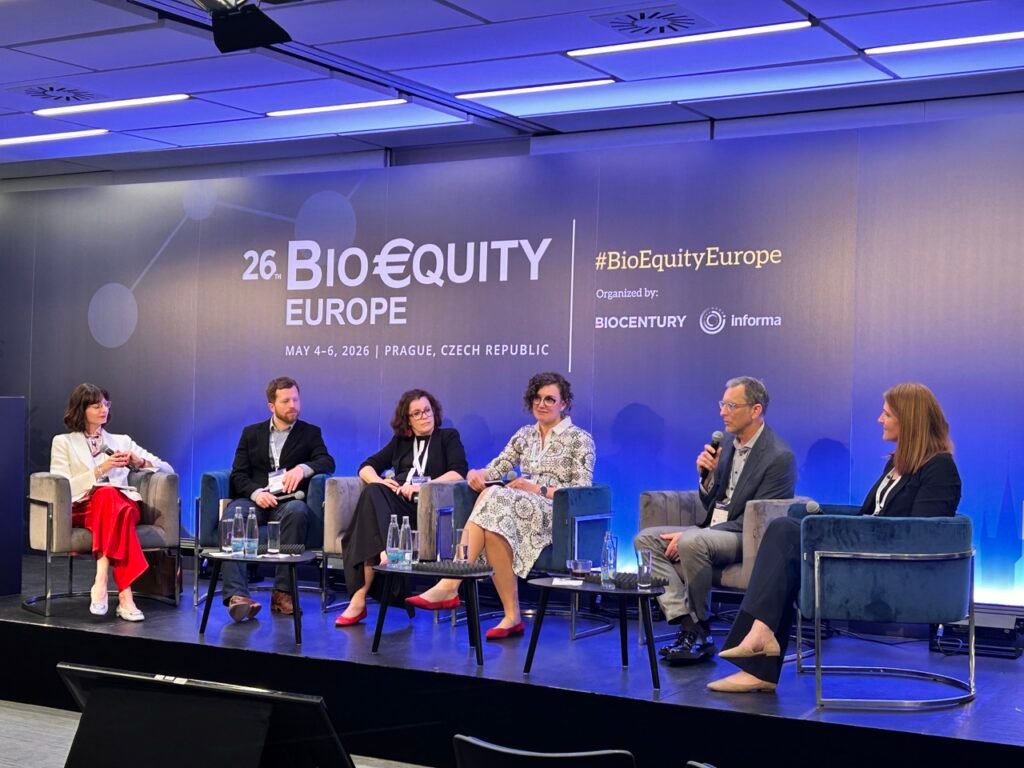
Proft shared her experience at BioEquity Europe 2026, during which Prague became, for a few days, the center of the European biotechnology industry. While the city still has some distance to cover before reaching that position in purely business terms, successful examples of Czech biotechnology are already demonstrating what is possible.
Don’t spend money until you have to
According to Prague.bio, the Czech biotechnology and life sciences sector comprises around 427 companies and research institutions, generating nearly CZK 100 billion in annual revenues. The sector employs approximately 32,000 people, most of them highly qualified professionals creating significant added value. Foreign direct investment in the field exceeded CZK 36 billion between 2003 and 2025. In the 2024/25 academic year, 12,000 students were enrolled in biology, biochemistry, and chemistry programs at Czech universities. Internationally, doctoral and postdoctoral researchers are often the founders of spin-offs — companies built around university research.
IOCB Prague is one of the country’s most successful scientific institutions. It is home to the discoveries of Antonín Holý, whose antiviral compounds became key treatments for HIV. Between 2023 and 2025 alone, licensing revenues from IOCB discoveries reached CZK 10.7 billion. The institute attracts scientists from dozens of countries as well as top Czech talent.
“A significant proportion of Czechs are natural tinkerers,” says Tomáš Cihlář, Vice President of Virology Research at Gilead Sciences and an IOCB alumnus. “When I was doing my PhD there, half the people were capable of building their own instruments or assembling them from spare parts. There’s a strong culture of ingenuity here,” he says, suggesting that this problem-solving mindset is deeply rooted in the region.
“As a region, we combine deep scientific thinking with a pragmatic approach to problem-solving and a strong awareness of resources. In other words: don’t spend money until you absolutely have to,” adds Katarína Pšeňáková, who leads the biological part of the newly established PharmTheon platform at IOCB Tech.
Experts consistently praise the Czech Republic’s location, infrastructure, research depth, and talent pool. Yet despite these strengths, the country is not among Europe’s leading biotech powers, and Europe itself is increasingly challenged by competitors, particularly China.
“There are still too few biotech startups here,” says David Stíbal, head of the i&i Prague incubator, which grew out of IOCB Prague. The incubator supports projects before they mature into investor-ready startups. Among its success stories are CasInvent Pharma, which is developing a treatment for leukemia, and Nanoflexion, a nanofiber patch designed to reduce complications and improve healing following intestinal surgery.
Stíbal highlights several areas of strength in the Czech ecosystem: nanotechnology, medical technologies, diagnostics, and the biological sciences in general.
“One area that has been growing faster than others in recent years is the intersection of artificial intelligence and drug discovery. We see many AI and machine-learning tools being developed here at a world-class level,” he says.
Globally, he identifies antibody-drug conjugates (ADCs) and radiopharmaceuticals as rapidly growing fields. Cell therapies, by contrast, have recently seen a decline in investor interest.
A missing entrepreneurial mindset
Why are there still so few startups? According to Stíbal, the reasons are largely historical and cultural.
“People here weren’t accustomed to entrepreneurship, and for many academics the concept of a startup remains unfamiliar,” he says. When mentoring university students, he often encounters the same binary career perspective: academia or a large established company such as Zentiva. The space in between — typically occupied by startups and scaling companies — is often missing from the narrative.
“We need more success stories. Once there are enough of them, the mindset will gradually change,” he predicts. At the same time, he insists that progress over the last five years has been tangible. More researchers now want to create startups and understand what that entails. Universities and research institutions are becoming better equipped to support commercialization, and grant programs increasingly emphasize practical applications and real-world impact.
Tomáš Cihlář illustrates this shift through two IOCB spin-offs.
The first is Adalid Sciences, operating in the lipid nanoparticle (LNP) field, a key technology for drug delivery.
“You could say there are fifty companies already competing in this space and that recent deals have set the bar extremely high,” he acknowledges. “But there is another way to look at it. Maybe everyone is chasing the same goose. The unique chemistry developed at IOCB, backed by a proven track record, may offer a different solution to some of the challenges surrounding LNP delivery.”
The second example is Taveren Therapeutics, founded at the end of last year and built around the concept of tumor suppressors naturally present in certain healthy tissues — a completely new direction for the field.
Afraid someone will steal the idea
Another obstacle, according to industry experts, is a tendency among researchers to keep projects hidden for too long.
“We leave things in the lab for too long before exposing them to reality. We’re afraid someone will steal the idea,” says Magdalena Marciniak, advisor to the i&i Biotech Fund. “In reality, what usually happens is that someone says: ‘That’s interesting. Let’s collaborate.’”
European biotech companies must also contend with growing competition from other regions, particularly China, which has become known for the speed at which it introduces innovations.
Proft referred to a presentation by McKinsey consultants at the conference, which noted that Chinese regulators have six weeks to comment on a clinical trial application. If they fail to respond within that period, approval is automatically granted.
“That would never happen here, and perhaps it shouldn’t,” she says. “But six weeks versus six months is a huge difference.”
Cihlář agrees.
“It’s difficult for this region to outperform the rest of the world on speed, especially China. But I don’t think that should be our objective. Our real advantage is originality, and originality needs time to mature into something truly unique.”
He also points to a growing divergence between the United States and Europe. In his view, U.S. drug-pricing policies — particularly the “most favored nation” concept — discourage some American companies from registering products in Europe at all.
“We’re on our own. So let’s accelerate, open up the environment, and make it more supportive,” he says.
Attractive science. And beer.
When the audience was invited to ask questions at the conference, one topic immediately emerged: the relocation of companies abroad and the so-called brain drain.
Many technology companies founded by Czech entrepreneurs are indeed headquartered outside the country. Often this is the result of a “flip,” where the company relocates its legal headquarters while keeping its R&D operations in the Czech Republic.
“If such a company emerges, we’re still happy to see it,” says Stíbal. “Of course, there is a risk that the local benefits will eventually disappear and the whole company will move to the U.S. But local talent remains employed, and until Europe can compete with the U.S. market — which it currently cannot — I would not advise fighting this trend.”
According to him, at least one company in i&i Prague’s portfolio follows this model: development remains in the Czech Republic, while headquarters and management are based in the United States.
“You have scientific excellence, brilliant minds, and a cost-effective workforce that would be much more expensive in the U.S. Add American networks, investment capital, and business standards, and you gain access to opportunities that would be difficult to achieve from a single country or region.”
These companies also bring back international standards, contacts, and know-how, enriching the local ecosystem.
So what about brain drain?
“These are some of the calmest places on Earth — even boring, in a positive sense,” said Jan Konvalinka, Director of IOCB Prague, speaking from the audience. “Considering what is happening in the United States, the Middle East, and Asia, being a safe haven is becoming increasingly attractive. We see it in academia. We are experiencing brain gain from the U.S., Western Europe, and Israel into Czech institutions.”
Stíbal agrees. “It’s an external effect. We see people returning. Every researcher coming back from the U.S. or elsewhere brings a different culture, new ideas, and a different way of thinking.”
Proft concludes with a smile:
“This is the first generation of scientists who gained experience abroad and are now returning home. One thing we are genuinely good at is retaining talent. I believe it’s because of the beer. And, of course, the quality of life in the Czech Republic is exceptionally high.”
The article was originally issued in Wired CZ
Author: Iva Brejlová